


Well Control surface equipment exercise – มาลองทำกันดูครับ ตัวอย่างข้อสอบเก่าๆ IWCF
COMBINED SURFACE-SUBSEA BOP – 10 questions
Well Control surface equipment exercise
- Using the BOP configuration illustrated in Figure below answer the following six questions by answering YES or NO. (The questions are based on whether the operations can be physically performed and do not represent the field practice or operating procedure of any company).

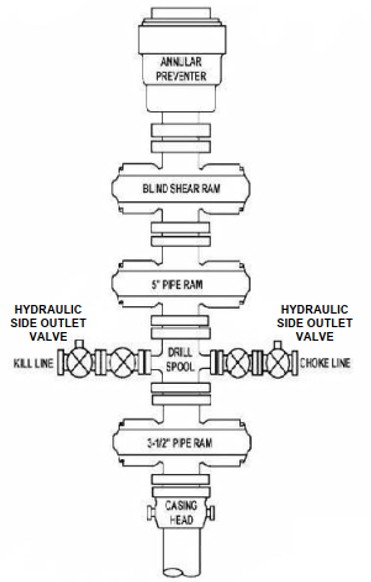
1a. With the well under pressure on 5 inch drill pipe, is it possible to repair a leaking flange on the drilling spool?
a) Yes.
b) No.
1b. With the well shut in under pressure and no drill pipe in the hole, is it possible to change the 3 1/2 inch rams to 5 inch rams?
a) Yes.
b) No.
1c. With the well shut in on 3 1/2 inch rams on 3 1/2 inch drill pipe under pressure, and with a safety valve in the string, is it possible to change the 5 inch rams to variable bore rams?
a) Yes.
b) No.
1d. With the well shut in on 5 inch pipe rams under pressure, is it possible to change the blind rams to 5 inch pipe rams?
a) Yes.
b) No.
1e. With the well shut in on 5 inch pipe rams under pressure, can the annular element be replaced?
a) Yes.
b) No.
1f. With the well shut in on 5 inch rams under pressure, can the manual valve on the choke line be replaced?
a) Yes.
b) No.
- What is a 7 1/16 inch 10,000 psi flange?
a) It has a 10,000 psi test pressure and 5000 psi rated working pressure.
b) It has a 7 1/16 inch OD and a 10000 psi rated working pressure.
c) It has a 10,000 psi rated working pressure and 7 1/16 inch ID.
d) It is designed for RX ring gasket type.
- What is understood by the expression “Stand-off between flanges” when installed and made up?
a) The external diameter of flange.
b) The internal diameter of flange.
c) The distance between the two flanges when installed with the studs and nuts tightened.
d) The total height of the two flange assembly.
- Which of the following rated working pressures does not match an API Type 6B flange?
a) 10,000 psi.
b) 2,000 psi.
c) 3000 psi.
d) 5000 psi.
- Which of the following statements about ring gaskets are correct? (Select TWO answers)
a) Type BX ring gaskets provide a pressure-energised seal.
b) Only BX ring gaskets can be used with BX type flanges.
c) Ring gaskets are designed to be used several times.
d) The same material specifications apply to ring gaskets as to ring grooves.
6. Given the volumes below, how much hydraulic fluid will be required to carry out the following operations (no safety margin)?
– Operations: Close then open
– Equipment : One annular preventer, Two pipe rams, One Shear/blind ram
Volumes:
– Annular preventer: 19 gallons to close 16 gallons to open
– Pipe ram: 7 gallons to close 6 gallons to open
– Shear/blind ram: 7 gallons to close 6 gallons to open
a) 61 gallons.
b) 68 gallons.
c) 74 gallons.
- The well is shut in on a kick using a ram BOP. The weep hole is seen to be leaking mud. It is possible to create an “emergency seal” to stop the leak. Which one of the following elements does it seal?
a) The well pressure.
b) The opening chamber.
c) The closing chamber.
- Which pressure should be used to determine the rated working pressure of the ram type BOP to be installed on the well.
a) Maximum anticipated surface pressure.
b) Maximum anticipated dynamic choke pressure.
c) Maximum anticipated hydrostatic drilling mud pressure.
d) Maximum anticipated MAASP.
e) Maximum anticipated bottom hole pressure.
f) Maximum anticipated formation pore pressure.
- Can ALL ram type BOPs close on Rated Working Pressure in the well bore when the hydraulic operating pressure is 1500 psi.
a) Yes.
b) No.
- During a routine test it is noticed that the weep hole (drain hole/vent hole) on one of the blowout preventer bonnets is leaking fluid. What action should be taken?
a) The weep hole only checks the closing chamber seals, leave it until the next maintenance schedule.
b) Primary ram shaft seal is leaking, secure the well and replace immediately.
c) Energize emergency packing. If leak stops, leave it until the next maintenance schedule
d) Ram packing elements on the ram body are worn out, replace immediately.
e) A leak here is normal because the metal to metal sealing face in the bonnet needs some lubrication to avoid damage.
- What is the purpose of the blind/shear rams?
a) To shear tubulars like drill pipe without sealing the hole.
b) To shear tubulars like drill pipe while simultaneously sealing the hole.
c) To effect a seal with drill collars in the hole.
- In which one of the following annular BOPs is „closure‟ not assisted by well pressure?
a) Hydril Model GL.
b) Hydril Model GK.
c) Cameron Model D.
- What pressure must be kept in the annular BOP closing chamber during a stripping operation?
a) The minimum pressure of BOP closure that ensures proper sealing.
b) The minimum pressure that allows the tool joint to go through the packing.
c) 500 psi.
d) 300 psi less than the closing pressure of the BOP.
14. There is only one inside BOP with an NC 38 (31/2 inch IF) pin/box connection on the rig.
The drill string consists of:
3 1/2 inch drill pipe (NC 38)
2 7/8 inch drill pipe (NC 31)
Which of the following crossovers must be on the rig floor for tripping?
a) NC 40 (4 inch IF) box x NC 26 (2 3/8 inch IF) pin.
b) NC 38 (3 1/2 inch IF) box x NC 31 (2 7/8 inch IF) pin.
c) NC 31 (2 7/8 inch IF) box x NC 38 (3 1/2 inch IF) pin.
d) NC 40 (4 inch IF) box x NC 35 pin.
15. Inside BOPs (stab-in non return safety valves) should be placed on the rig floor at all times, ready for use, to fit the tubulars being used
Which of the following are correct for this type of valve?
(Select THREE answers)
a) Will not allow wire line to be run inside the drill string.
b) Is kept in its open position by a rod secured by a T-handle.
c) Has to be pumped open to read Shut In Drill Pipe Pressure (SIDPP).
d) Can be run in hole in the open position.
e) Easier to stab than a drill pipe safety valve when flow is encountered up the drill string.
f) Has a potential to leak through the open / close key.
16. If a standard float valve (non-return type) is installed in the string, is greater surge pressure generated when tripping in?
a) Yes.
b) No.
17. During a tripping operation a conventional flapper type float valve is installed in the bit sub in the closed position. What effect does this have on the operation when tripping into the well? (Select THREE answers)
a) If the drill pipe is not filled the risk of hydraulic collapse will increase.
b) Returns to the trip tank increase.
c) Surge pressure on the formation will reduce.
d) Back flow through the drill string increases.
e) Surge pressure will increase if tripping speeds are not decreased.
f) Reverse circulation may be performed at any time..
- What is an Inside Blowout Preventer?
a) A ball valve installed immediately above the bit.
b) A device that can be installed in the drill string to act as a non-return valve.
c) An element inserted into the annular preventer to reduce the inside diameter.
- Figure illustrates a style of diverter commonly used when drilling with a surface BOP.

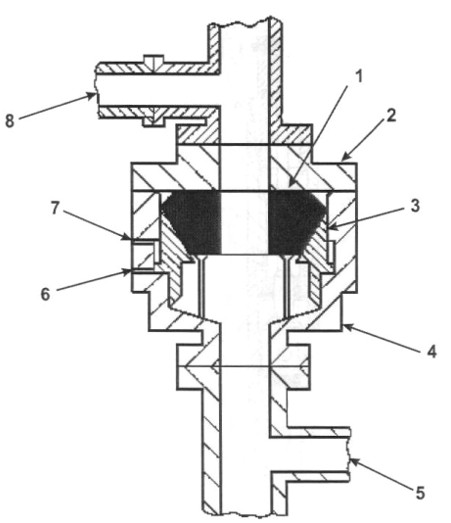
Match the correct numbers to the descriptions below.
(One point for each correct answer).
19a. ___ Vent line
19b. ___ Diverter open port
19c. ___ Head
19d. ___ Actuating piston
19e. ___ Annular packing element
- What is the API RP53 definition of “Rated Working Pressure”?
a) The test pressure that equipment is designed to contain or control.
b) The proof test of a body or shell member.
c) The maximum internal pressure that the equipment is designed to contain or control.
d) Twice the rated working pressure of the tool used (up to 5000 psi).
- When should well control equipment on a surface BOP installation be pressure tested?
(Select TWO answers)
a) After the disconnection or repair of any pressure containment seal in the BOP stack, choke line or choke manifold.
b) At intervals not exceeding two months.
c) Prior to spud or upon installation.
d) After circulating out a gas kick.
- When testing the BOP stack with a test plug or cup type tester, why is pressure communication maintained from below the tool to atmosphere?
a) To avoid swabbing a kick during a test.
b) Otherwise reverse circulation will be needed to release the tool.
c) To avoid potential damage to the casing/open hole.
d) To avoid the creation of extreme hook load.
- According to API RP 53, the components that could be exposed to well pressure should be tested on location. The first test is called the “initial high- pressure test”. The following tests are called, “subsequent tests”.
To which pressure should the lower Kelly cock, upper Kelly cock, drill pipe safety valve and inside BOP be tested at the “subsequent tests”?
a) Twice the rated working pressure of the tool used (up to 5000 psi).
b) One and a half times the rated working pressure of the tool used.
c) Always use a pressure equal to 10,000 psi.
d) Test to a pressure at least equal to maximum anticipated surface pressure, but limited to the maximum rated working pressure of the BOP stack in use.
- What is the maximum recommended closing time for a 13 5/8 inch annular surface BOP according to API RP 16E?
a) 2 minutes.
b) 30 seconds.
c) 45 seconds.
- What is the normal operating position of 3 position – 4 way valves on the hydraulic BOP control unit while drilling with a surface BOP stack installed?
a) All valves in closed position.
b) Open or closed depending on BOP stack function.
c) All valves in neutral (Block) position.
d) All valves in open position.
- API RP 16E states that each closing unit should be equipped with a sufficient number and size of pumps to satisfactorily perform the closing unit capacity test.
“With the accumulator system isolated, the pumps should be capable of closing the annular preventer, (excluding the diverter) on the maximum size of drill pipe being used, open the hydraulically operated choke line valve(s) and provide the operating pressure, recommended by the manufacturer of the annular BOP, to effect a seal on the annulus. This should be achieved within?”
a) 4 minutes.
b) 1 minute.
c) 2 minutes.
d) 3 minutes.
- Which gas is used to pre-charge the accumulator bottles on a hydraulic BOP control unit?
a) Oxygen.
b) Methane.
c) Carbon dioxide (CO2).
d) Nitrogen.
e) Air.
28 If the air pressure gauge on an air operated BOP control panel reads zero, which of the following statements is true?
a) No stack function can be operated from the remote panel.
b) The annular preventer can still be operated from the remote panel.
c) All stack functions can be operated from the remote panel.
d) Choke and kill line valves can still be operated from the remote panel.
29. What is the function of the master control valve on an air operated remote BOP control panel?
a) It supplies hydraulic fluid to the panel.
b) It activates the air supply to the panel.
c) It activates the electric circuit for the open / close lights.
d) It adjusts pipe ram closing pressure.
30. Which function on a BOP stack is supplied from the annular pressure regulator?
a) No function is supplied with this pressure; the value on the gauge only indicates the maximum allowable working pressure for the annular preventer in use.
b) Ram preventer, annular preventer and hydraulically operated choke and kill line valves.
c) Annular preventer and hydraulically operated choke and kill line valves.
d) Annular preventer only.
e) Rams and hydraulically operated choke and kill line valves.
31. What is the usable hydraulic fluid volume of an accumulator system according to API RP 53?
a) The total volume recoverable from the bottles between the accumulator operating pressure and pre-charge pressure.
b) The total volume recoverable from the accumulator system between the maximum operating pressure and 200 psi above pre-charge pressure.
c) The total volume to be stored in the accumulator bottles.
d) The total volume recoverable from the bottle between the accumulator operating pressure and 500 psi above the pre-charge pressure.
32. What is the minimum capacity of a hydraulic fluid reservoir on the hydraulic fluid reservoir on the hydraulic BOP control unit recommended by API RP 53?
a) Equal to twice the closing volume of the BOP.
b) At least twice the usable fluid capacity of the accumulator system.
c) At least equal to the usable fluid capacity of the accumulator system.
33. 3 position – 4 way valves are used on the hydraulic BOP control unit to control surface stack functions. Which of the following statements are true? (Select TWO answers)
a) They have four active hydraulic connections (inlets/outlets).
b) They can be manually operated.
c) They cannot be operated from the remote BOP control panel.
d) They can be placed in 4 positions
34. Which of the following is the correct procedure to activate a BOP function from the Drillers remote control panel on a surface BOP stack installation?
a) The BOP function is depressed then released. The master button must then be activated.
b) The master button must be activated for 5 seconds and then released before a BOP function is depressed.
c) The master button must be activated while a BOP function button is depressed.
- Only a small volume of fluid is required to operate the hydraulic valves on the BOP side outlet connections on a surface BOP installation.
If the Driller pushes “Master” and “Choke open” simultaneously he observes the lights change color.
Does the changing lights confirm that the choke line valve is in the open position?
a) Yes.
b) No.
- The gauges on the Driller‟s remote BOP control panel are used to observe the status of the surface BOP control unit while drilling.
Figure shows a set of gauge readings with the change that is occurring (the BOP has not been operated and the electrically driven pump is not running).

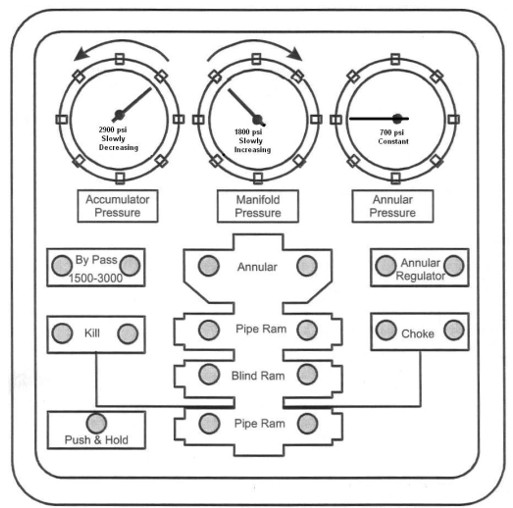
What is the likely reason for the change?
a) Everything is correct.
b) Problem with the hydraulic pressure regulating valve.
c) Problem with the automatic hydro-electric pressure switch.
d) Leakage on the hydraulic circuit.
- Which of the following is used to operate the remotely operated valves on the choke line?
a) Hydraulic fluid.
b) Nitrogen.
c) Wires.
d) Air. - In figure S7-004, which dimension(s) determine the back pressure generated within the handling capacity of the mud-gas separator?

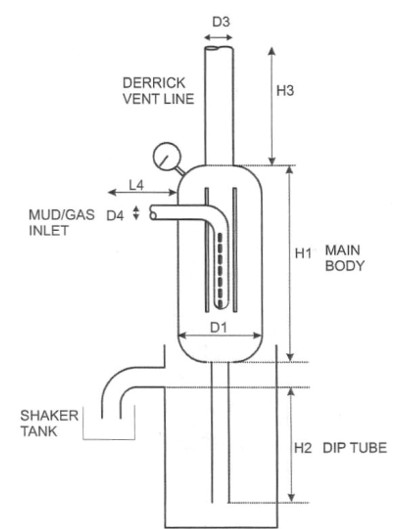
a) H1 and D1.
b) H2.
c) H3 and D3.
d) L4 and D4
- Use the illustration of the mud/gas separator in figure S7-005 and the following data to calculate the operating pressure at which gas blow-through may occur.
H1: Body height = 30 feet H2: Dip tube height = 15 feet
H3: Derrick vent line height = 150 feet Mud density = 11.5 ppg
a) 8.97 psi.
b) 89.7 psi.
c) 17.94 psi
40. What is the most common use of a Vacuum Degasser?
a) It is mainly used to separate gas from liquids while testing.
b) It is used as a standby in the event of the “Mud/Gas Separator (Poor Boy)” failing.
c) It is only used while circulating out a kick.
d) It should be used to remove gas from the mud when drilling, circulating or killing a well.
Answer
1a. B
1b. B
1c. A
1d. A
1e. A
1f. B
- C
- C
- B
- A, B
- C
- A
- A
- B
- B
- B
- C
- A
- B
- A, B, C
- A
- A, B, E
- B
19a. 5, Vent line – 19b. 7, Diverter open port – 19c. 2, Head – 19d. 3, Actuating piston – 19e. 1, Annular packing element
- C
- A, C
- C
- D
- B
- B
- C
- D
- A
- B
- D
- B
- B
- A, B
- C
- B
- B
- A
- C
- A
- D