



COMBINED SURFACE-SUBSEA BOP – Driller ทั้งหลายที่จะไปเข้า IWCF course มาทดสอบกันครับ อิอิ
ผมจะไม่แปลนะ เพราะของจริงก็ภาษาอังกฤษนะ
COMBINED SURFACE-SUBSEA BOP
For all questions, only select the answers that apply.
(รูปจะอยู่เหนือโจทย์นะครับ)

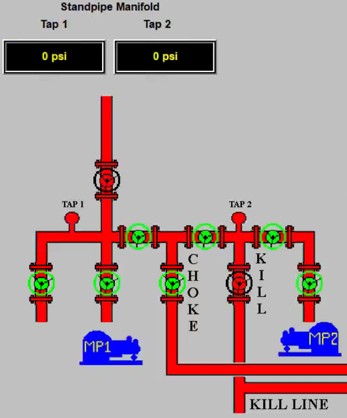
- Prior drilling we are lining up the Standpipe Manifold. What should be changed?
a) Open valve to kill line.
b) Close valve to mud pump 2.
c) Open valve to standpipe.
d) Close bleed-off valve.
e) No change, leave everything as is.
f) Close choke line valve

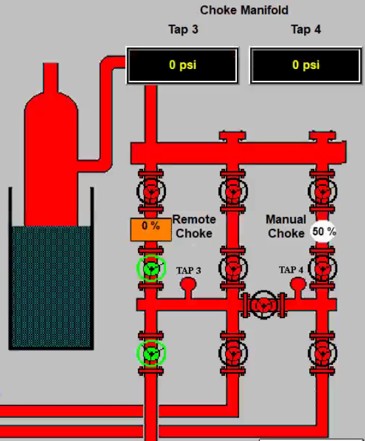
- Prior drilling we are lining up the Choke Manifold. What should be changed?
a) Open valve downstream of choke.
b) Open remote choke.
c) Close manual choke.
d) Open bypass valves.
e) No change, leave everything as is.
f) Close valve upstream of choke.

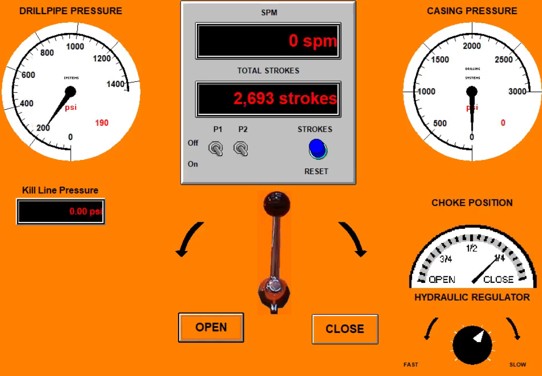
- Prior drilling we are checking up on the Choke Panel. What must be changed?
a) Equalize casing pressure with drill pipe pressure.
b) Zero total strokes counter.
c) Close remote choke.
d) Open choke to 50%.
e) No change, leave everything as is.
f) Bleed off trapped pressure in standpipe.

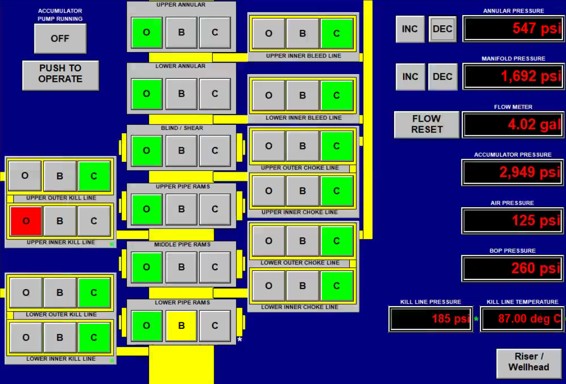
- Prior drilling we are checking up on the Subsea BOP Panel. What must be changed?
a) Close upper inner kill line valve.
b) Ask subsea engineer to change LED lights from green to red on kill/choke line valves.
c) Increase accumulator pressure to 3000 psi.
d) Increase Annular Pressure to 1500 psi [if manufacturer is Cameron/Shaffer].
e) Increase Annular Pressure to 1500 psi [if manufacturer is Hydril].
f) Reset the flow meter to zero.
g) Decrease manifold pressure to 1500 psi.
h) Increase manifold pressure to 3000 psi.
i) No change, leave everything as is.
j) Increase the manifold pressure to 3000 psi.
k) Change lower pipe rams from block-open to open

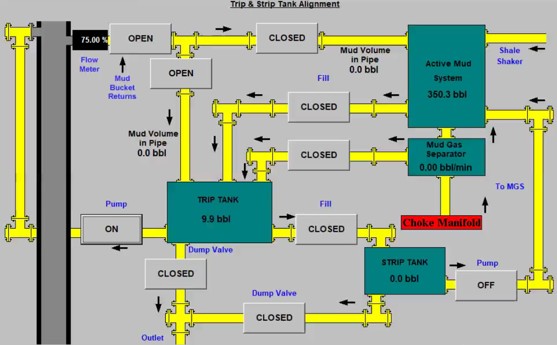
- Prior drilling we are checking up on the Line Up. What should be changed?
a) Open the line between mud gas separator and trip tank.
b) Open the return line to the active mud system.
c) Switch off the trip tank pump.
d) Close the return line to the trip tank.
e) No change, leave everything as is.
f) Open the line between active mud system and trip tank.

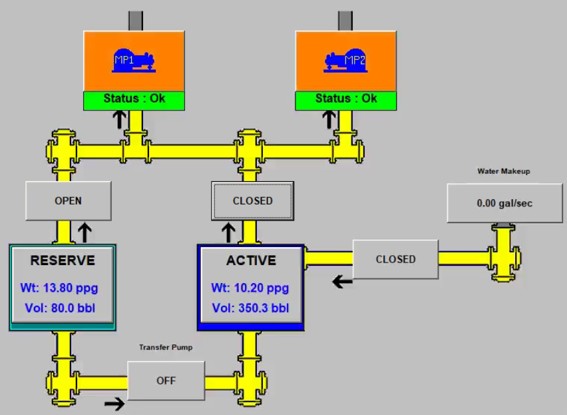
- Prior drilling we are checking the line up to Mud Pumps. What should be changed?
a) Switch on Transfer Pump between Active and Reserve Tanks.
b) Close valve to mud pump 2.
c) Open valve between mud pumps and Active Tanks.
d) Close valve between mud pumps and Reserve Tanks.
e) No change, leave everything as is.

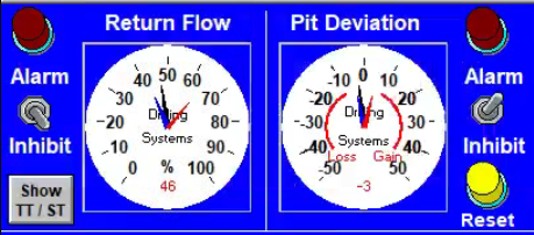
- Prior drilling we are setting the return flow alarm to +/- 5% and pit deviation alarm to +/- 5 bbls. What should be changed?
a) Return flow high alarm changed to 51%.
b) Increase the flow rate.
c) Pit deviation to be reset to zero.
d) Alarm of pit deviation to be switched on.
e) No change, leave everything as is.
f) Alarm of return flow to be switched on.

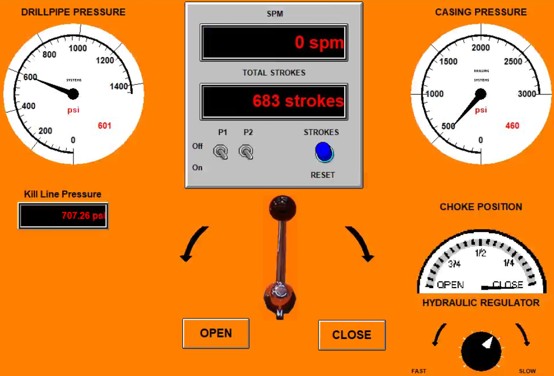
- After the Driller has shut in the well, we are checking up on the Choke Panel. What must be changed or checked?
a) Casing pressure appears to be low. Check pressure gauges and line up.
b) Bring the choke to the mid-way [50%] position.
c) Close the subsea kill line valves and bleed off pressure.
d) No change, leave everything as is.
e) Start the pump with 30 strokes and gradually open the choke.
f) Zero total strokes counter.

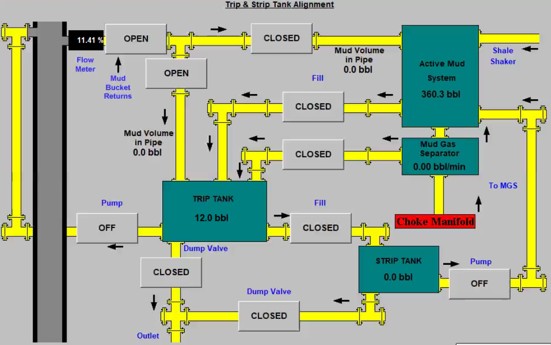
- After the Driller has shut in the well, we are checking if everything is okay, including the Line Up. What must be changed?
a) Switch on the trip tank pump.
b) Open the return line to the active mud system.
c) Close a ram BOP as soon as possible.
d) Stop the pumps.
e) No change, leave everything as is.
f) Check the recordings of the trip tank.

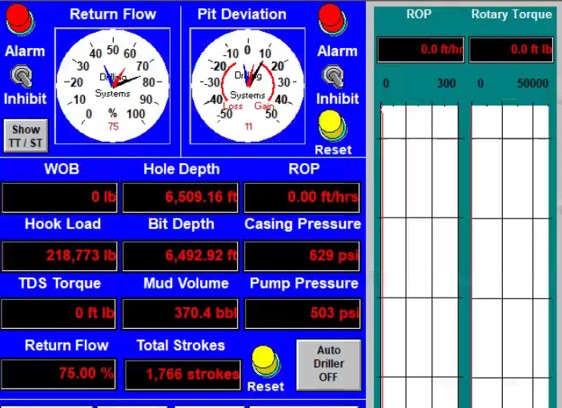
- After the Driller has shut in the well and just before we start circulating out the influx, we are checking the Driller’s Graphic Screen. What must be changed?
a) Reset the pit deviation to zero.
b) Set the trip tank return flow on +/- 5 bbls and switch on alarm.
c) Zero total strokes counter.
d) Change display to Drill Pipe/Casing pressure and/or Pit Deviation.
e) No change, leave everything as is.
f) Hang off drill string on lower pipe rams.
COMBINED SURFACE-SUBSEA BOP
ANSWERS
1 c, d and f Valves to choke and kill line must remain closed, as they will only be used for non-drilling related situations. We only have one standpipe, which remain open. The bleed-off valve must also remain closed. We will use two pumps and they are run in parallel with valves in between in an open position.
2 a and c All valves or chokes that are not [immediately] used for circulation through the choke manifold should remain closed. Therefore, the manual choke must be closed. The valve downstream of the choke should remain open. The valve upstream of the choke is often closed as well [as dictated by Company policy], because the choke is not considered a valve and could leak while observing pressures. In the simulator exercise[s] we leave this choice [i.e., valve open or closed] to the candidate.
3 c and f We should not have any pressure on the drill string. This must be checked out and we should bleed off any trapped pressure in the standpipe line. For a hard shut-in, the remote choke must be in a closed position. Strictly speaking, there is no need to zero the stroke counter, because we will be in drilling mode and not use the choke panel unless we would be in well kick situation.
4 a, d and h The upper inner kill line valve must be closed.
The lower pipe rams are open but the opening and closing pressures are vented and the ram is shown to be in block position. Rectify and apply full opening pressure to the lower pipe rams.
If the Annular Preventer is made by Hydril [e.g., GK, GX etc.], then we usually have a closing pressure between 700 and 1200 psi. However, if the Annular Preventer is made by either Cameron or Shaffer, then we usually have a closing pressure of 1500 psi.
Manifold pressure on this system should be regulated to 1500 psi. The flow meter should be reset to zero. The accumulator pressure will only return to 3000 psi once the electric-hydraulic switch kicks in the charge pump at 90% of accumulator pressure, which is 2700 psi.
5 b, c and d The line up is correct for tripping, but not for drilling. The trip tank pump can be switched off, the valve to the trip tank be closed and the valve to the active mud system opened. All other valves in this set-up remain closed.
6 c and d Both pumps should be lined up the active mud system. Therefore the valve to the reserve tanks [with 13.8 ppg kill mud] should be closed and the valve to the active tanks [with current mud weight of 10.2 ppg] should be opened. All other systems to be switched off or isolated.
7 a, c and f The return flow meter setting on the high end should be set at 51% [5% higher than flow of 46%] and the flow meter alarm should be switched on. The pit deviation should be reset to zero. The pit deviation setting [+/- 5 bbls] appears to be correct.
8 a and f Upon shutting in the well and with the choke- and kill line valves open to the choke manifold, the casing pressure should be higher than the drill pipe pressure.
Note that the kill line pressure is likely to show the correct pressure, but the casing pressure does not! Check the line-up and any alternate pressure gauges to find the cause of this discrepancy in pressure and do not start up circulation until this anomaly is rectified. We also need to zero the stroke counter.
9 c and f With the Annular Preventer closed and the trip tank pump still in an ‘off’ position we should not have any flow! It is obvious that the Annular Preventer is leaking, and the Driller did not observe this. Close the Ram Preventer as soon as possible, but be aware of the space out [do not close on a tool joint] and check with the Driller first.
We also need to find out how many barrels have leaked past the leaking Annular Preventer by checking the recordings of the trip tank and compare with the level prior shutting in the well. Only then we will have a more accurate influx volume to work with.
10 b, c and d The return flow indicates that we have the trip tank switched on, but the return flow has not been reset, nor has the alarm been switched on. The pit deviation should not be reset, because this represents the pit gain [influx volume], which will be monitored during all circulations [either Driller’s Method or Wait & Weight Method].
It would be good practice to zero the stroke counter [as a back up to the one on choke panel]. The Driller should monitor and record drill pipe pressure, casing pressure and pit gain/deviation, and for this reason we should change the display. This makes it easier to detect any trend change or a quick change in pressure or volume.
COMBINED SURFACE-SUBSEA BOP